Locked Out of the Lab: How Junior Scholars Are Shut Out of High-Impact Research Networks
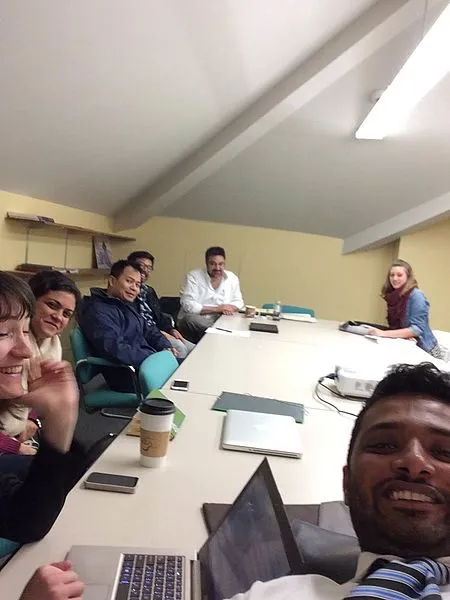
Photo: Sanjev Rajaram, CC BY-SA 4.0, via Wikimedia Commons
Collaboration has become the currency of modern science. Multi-institutional partnerships, interdisciplinary consortia, and co-authored landmark studies now define what it means to do research at the frontier. Yet for thousands of graduate students, postdoctoral fellows, and early-career faculty across the United States, this collaboration economy operates behind a door they were never handed a key to.
The result is a two-tiered research landscape: one populated by established scholars who circulate through elite professional networks, and another where promising junior researchers develop in relative isolation, their potential contributions stalled by a lack of access rather than a lack of talent.
The Structural Architecture of Exclusion
To understand why early-career researchers are left behind, it is necessary to examine the informal scaffolding that governs how collaborations are actually formed. Despite the existence of formal institutional mechanisms — departmental seminars, conference programming, faculty directories — the most consequential research partnerships tend to originate through personal relationships cultivated over years of shared professional history.
This dynamic places junior scholars at a structural disadvantage from the outset. A postdoctoral researcher at a mid-tier R1 university may produce work of genuine distinction, yet remain invisible to the senior investigators who assemble the multi-site teams that attract NSF or NIH funding. Without an established mentor who actively circulates that researcher's name in the right rooms, career-defining opportunities simply do not materialize.
Institutional hierarchies compound the problem. In many departments, the informal expectation is that junior researchers will serve existing projects rather than propose their own collaborative agendas. This apprenticeship model, while not without merit, can extend indefinitely — leaving talented scholars in subordinate roles well past the point at which their intellectual contributions warrant equal partnership.
What Exclusion Actually Costs
The career consequences of being locked out of collaborative networks are measurable and lasting. Research consistently demonstrates that co-authorship with senior scholars accelerates citation impact, increases grant success rates, and expands the professional visibility that drives hiring and promotion decisions. Researchers who lack access to these networks early in their careers face a compounding disadvantage: each year spent outside high-impact collaborations is a year in which the gap between their professional profile and that of better-connected peers widens.
Beyond individual careers, the scientific enterprise itself bears a cost. When talented early-career researchers are excluded from the collaborative structures through which transformative work is produced, entire bodies of potential knowledge go undeveloped. Innovation does not only flow from established investigators; it frequently emerges from the unconventional questions that junior scholars, unburdened by disciplinary orthodoxy, are uniquely positioned to ask.
There is also a diversity dimension that warrants serious attention. Informal gatekeeping in collaborative networks tends to reproduce existing demographic patterns in senior faculty. Researchers from underrepresented groups, first-generation academics, and scholars without elite institutional affiliations are disproportionately excluded from the professional networks that matter most — a reality that undermines the broader commitment of American research institutions to building an equitable scientific workforce.
Case Studies in Getting It Right
Some institutions have moved deliberately to disrupt these dynamics. The University of Michigan's Rackham Graduate School has implemented structured mentorship cohorts that explicitly pair doctoral candidates with faculty beyond their immediate dissertation committees, creating lateral networks that persist across departmental boundaries. Participants report not only expanded professional connections but a measurably greater sense of belonging within their disciplines.
At the national level, the National Science Foundation's Research Coordination Networks program has demonstrated how structured, grant-funded frameworks can lower the barrier to collaborative entry for researchers at all career stages. By requiring that participating networks include explicit provisions for early-career engagement — including co-investigator roles, not merely advisory positions — the program has created pathways that informal networks historically did not provide.
On the platform side, tools such as the NIH's Collaborative Research Supplement and emerging digital infrastructure like ORCID-integrated matchmaking systems are beginning to make researcher expertise and availability more legible across institutional boundaries. When a postdoctoral fellow in materials science at a regional university can be algorithmically surfaced as a potential collaborator for a senior investigator at MIT, the geography of professional opportunity begins to shift.
Recommendations for Research Institutions
Addressing the mentorship gap requires more than well-intentioned programming. Institutions serious about democratizing access to collaborative networks must act on several fronts simultaneously.
Formalize sponsorship as a faculty responsibility. There is a meaningful distinction between mentorship, which transmits knowledge and guidance, and sponsorship, which actively advocates for a junior researcher's inclusion in high-value opportunities. Institutions should incorporate sponsorship expectations into faculty review processes, making visible advocacy for early-career colleagues a recognized professional contribution.
Restructure grant credit systems. Current norms around principal investigator designations frequently prevent early-career researchers from receiving the formal credit that would make their collaborative contributions legible to hiring and promotion committees. Institutions and funding agencies should work together to develop crediting frameworks that accurately reflect the contributions of junior team members.
Invest in cross-institutional matchmaking infrastructure. Professional societies and research hubs — including collaborative networks like PAA-CI — are well positioned to facilitate connections between junior researchers and established investigators across institutional boundaries. Structured speed-networking events, collaborative seed grants, and mentorship registries represent practical, scalable interventions.
Audit collaborative participation data. Institutions should track who is participating in multi-investigator grants, consortium memberships, and co-authored high-impact publications — and disaggregate that data by career stage, department, and demographic characteristics. What gets measured gets managed.
Opening the Door
The collaboration economy is not going away. As the complexity of scientific questions grows and the resources required to address them expand, partnership will remain the dominant mode of frontier research. The question is not whether junior scholars will need to navigate collaborative networks, but whether American research institutions will choose to build those networks in ways that are genuinely open to the next generation of investigators.
The case for doing so is not merely ethical, though the equity dimensions are real and pressing. It is also strategic. The United States maintains its position at the leading edge of global research in part because it draws on an extraordinarily broad base of scientific talent. Allowing informal gatekeeping to narrow that base — to concentrate collaborative opportunity among those who already have the most — is a structural inefficiency that the American research enterprise cannot afford.